
Light Code Meditation
A meeting of sound, contemplation and presence

LIGHT CODE MEDITATION
A simple and deep meditation
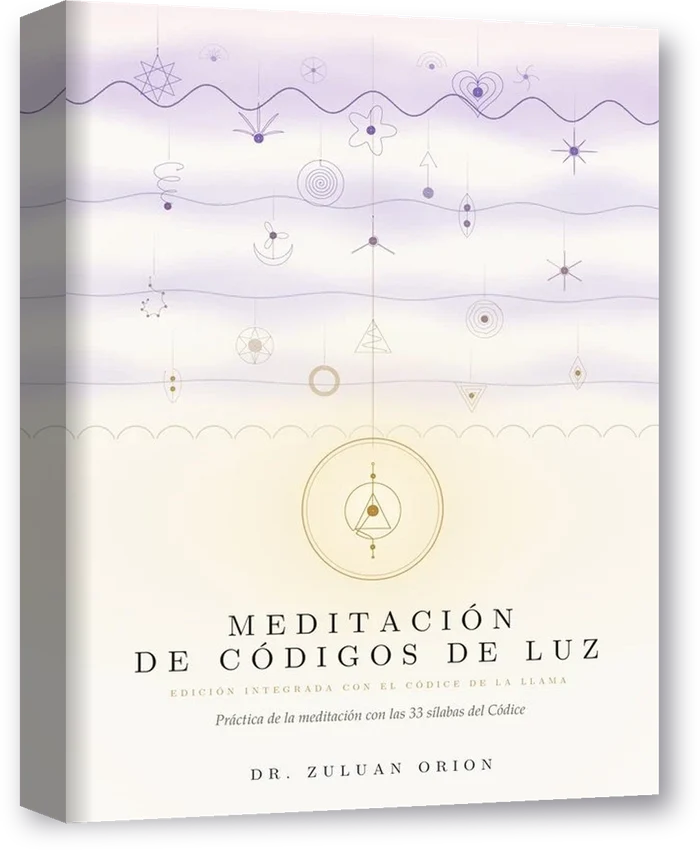
Meditation has been at the centre of my life, and I have had the privilege of initiating thousands of people into it. I used to teach it with the bija mantras, the seed sounds of the tradition of India. Today I share it with the syllables of the Flame Codex.
Each syllable is chosen for what it is and what it does, not because it sounds like another. It is a door to a quality that already lives in you: serenity, clarity, rootedness, devotion.
The practice is simple. You begin with an intention. You look at the plate, if you have it. You let the syllable keep you company. And then you rest in silence. What you contemplate there, you carry afterwards into your life.
The crown receives. The heart translates.
The root incarnates. Life demonstrates.
WHAT YOU NEED
Nothing special
A quiet place, a few minutes and a sincere intention. That is enough to begin. The practice brings together six simple things:
The syllable opens a door. Contemplation makes its quality familiar.
Silence gives it room. And your daily life makes it real.
WHY MEDITATE THIS WAY?
To relate differently to what you live
To learn to look at your thoughts, emotions and sensations without believing you are each one of them. And so that qualities like these can find a place in your life:
Presence · Clarity · Serenity · Discernment · Devotion · Rootedness · Receptivity · Will · Integration
Its meaning becomes concrete in small things: listening with more attention, answering with more clarity, holding a limit, acting with more coherence.
In the language of the Codex we say this practice prepares the human vessel so that the Flame, the Divine Intelligence entering incarnation, can express itself. But the Descent belongs to Grace: no technique and no syllable can guarantee it. When the practice speaks of making room for the descent, I mean a willingness: allowing what you contemplate to find body and expression. It does not mean that each session produces a new Descent.
YOUR SUPPORTS
Intention, syllable, gaze and the Observer
THE INTENTION
What do you wish to contemplate?
Before you begin, recognize it and say it simply, in harmony with what the syllable you chose does:
“I want to be present.”
“I want to accompany this emotion with serenity.”
“I want to see my next step clearly.”
“I want a more intimate relationship with the sacred.”
Once recognized, you do not need to repeat it: let it rest in the silence too. Intention gives you a direction; it does not oblige you to get a result.
THE SYLLABLE
A sound that keeps you company
You can say it softly or remember it inwardly, as its study page indicates. Pronounce it with care and without strain. You do not have to hold it with force the whole session: when it grows faint, let it rest in silence. If you get lost in your thoughts, remember it gently and rest again. There is no required number of repetitions.
THE PLATE
An image for the gaze
Look at it softly, without straining your eyes or analysing every detail. You can contemplate it before closing your eyes or during part of the session. If the image disappears when you close them, that is fine: carry on with the intention, the syllable, or simply being present. And if you have no plate, sound and presence are enough.
The plate is for contemplating, not for taking a trace from. When a practice includes tracing, the key’s original sign and its verified route are used.
THE OBSERVER
The awareness that notices
I call the Observer that awareness in you that notices what appears: thoughts, emotions, sensations, memories, images, sounds, silences. Observing is not policing every thought: it is noticing, and kindly coming back when you get distracted. And you do not have to feel separate from your body or your emotions: presence includes them too.
A SESSION, STEP BY STEP
The six scenes
This is what a session looks like, in six simple moments that accompany the five stages of the method.
THE METHOD
Five stages
- Recognize the qualityBe clear about your intention and the syllable you chose. Notice how you arrive, how your body is. You can begin even if thoughts or emotions are present.
- Open the inner relationshipLet attention gather. Sound, breath and presence grow simpler. If you get distracted, come back gently.
- Make room for the descentLet the quality you contemplate touch your human, bodily experience: from the mind to the heart, to vitality, to the root and to the body. You do not have to visualize or feel something in each place.
- Observe and allowGive room to what appears. The syllable may grow faint: rest without chasing it. If an emotion arises, recognize it without forcing it to grow. If something becomes too much, open your eyes, look around you and stop the practice.
- Return and integrateFeel your hands, your feet, your breath and the sounds of the place again. Move gently and open your eyes at your own pace. Integration continues when what you contemplated becomes a gesture in your day.
BEFORE YOU BEGIN
Begin from where you are
Find a corner where you can be quiet for a few minutes. If you use a plate, place it at a comfortable distance; if it is on a screen, lower the brightness so it does not tire your eyes. Sit on a chair or a stable support, back upright but not rigid, hands resting, feet or seat as your support. No posture should hurt. Recognize your breath as it comes and soften your face and shoulders. Preparing is simply recognizing how you are and allowing yourself to begin from there.
How long?
Begin small and regularly. Five or ten minutes is a good start; fifteen or twenty if you feel comfortable. These times do not measure your depth and are not a requirement. Give yourself a moment to arrive and a minute or two to return. A fairly fixed time and place help. Constancy grows by coming back, not by competing.
Silence
Silence is the heart of this meditation. The syllable orients and then leaves room; it does not have to be held by force for the session to have meaning. There can be thoughts and sounds and, even so, rest. When you notice you have gone off after a mental story, return once to the sound or the body, and rest again. That is how attention learns to come back without fighting itself.
THE FIRST SYLLABLE
AHR · ÁR
Opening and anchoring of the primordial Flame. In the Codex it relates to the centres of the root, the heart and the crown. In the book I use it to teach you how to prepare the body, contemplate, bring in the sound and rest. To begin:
- Remember ÁR inwardly during a soft inhalation.
- Let any pause be natural.
- As you exhale, let your attention go along the spine down to where your body rests.
- Do not force your throat or hold your breath.
- Then leave room for silence.
This guidance belongs to AHR; each syllable has its own.
A GUIDED MOMENT WITH AHR
Meditate with me
Sit comfortably.
Let your weight find its support.
Feel your hands, your feet and the seat.
Recognize one breath.
Let the next one come.
Remember the intention of opening and presence.
If you have the plate, look at it softly.
Receive the image as a whole.
You may close your eyes when it feels comfortable.
Remember ÁR inwardly during a soft inhalation.
As you exhale, let your attention go
along the spine down to where your body rests.
Now leave room.
You do not need to hold the sound.
Stay with what appears.
If you notice you are following a thought, come back kindly.
You may remember ÁR softly and let it rest again.
Remain a few moments in silence.
When it is time to finish, feel your hands and feet.
Listen to the sounds of the place.
Move your body gently. Open your eyes at your own pace.
Before you go on, recognize one simple gesture of presence you can carry into your day.
CHOOSING THE SYLLABLE
Where do I begin?
Begin with your life, not with the list. Ask yourself: What needs attention right now? Do I need clarity, serenity, direction, receptivity, rootedness, or a more conscious way of relating to what I feel? Then look at the study page of that syllable and talk it over with whoever accompanies you. The first practice uses AHR, to learn the way.
The book gathers the 33 syllables at the heart of the Codex, but their order is not a calendar and you do not have to go through them all. These are some of the ones I present in the guide; they are chosen according to your intention, not recited all together:
Each one keeps the indications of its own study page. A Support syllable can be contemplated on its own without becoming a Core within a triad.
FROM ONE SYLLABLE TO A TRIAD
Your first triad: settling into deep stillness
Once a simple practice feels familiar, you can get to know the combinations. The first one I teach, for settling into deep stillness, is:
Opens and orients: opening and anchoring.
Holds: foundation, rooting and consolation.
Closes: stillness and completion.
In the guide you become familiar with its sound in that order, with comfortable pauses, and then you rest. There is no required number of repetitions. This is different from the full ritual with traces: when the traced invocation is performed, the verified signs of the three keys are used, with their own instructions. Triads are studied with accompaniment, respecting the role of each key.
WHAT MAY HAPPEN
Every session is different
There may be stillness, distraction, emotion, sensations in the body, or a session that feels completely ordinary. No phenomenon proves you went deeper.
If many thoughts come
Notice that you are thinking, and come back kindly to the support you chose.
If you cannot see the plate inwardly
Carry on with the syllable, the intention, or simply the presence of your body.
If you feel nothing special
Write the session down as it was. It is not a failure, and there is no need to imagine invisible effects you cannot observe.
If images or messages appear
You can write them down as inner experiences. They are not orders you have to obey.
If an emotion comes up
Give it room, as much as you can hold, without pushing it into a catharsis.
If it becomes too much
Open your eyes, look around you and stop. Ask for accompaniment if you need it.
AFTER MEDITATING
Meditation continues in your day
When you finish, you can ask yourself: What did I observe? What meaning do I give it? What simple gesture could express today the quality I contemplated? For example:
Let it be something possible and concrete. You do not need to repeat the syllable all day: the quality can stay alive after the sound has ended.
A SMALL JOURNAL
What you observe, and what you interpret
| Date | |
| Approximate duration | |
| Syllable or triad | |
| Intention | |
| What I observed | |
| How I interpret it | |
| Gesture of integration |
It helps to tell what you observe from what you interpret. “I felt warmth in my chest” is a sensation; “I think it has to do with an emotion” is an interpretation. That way you recognize changes without crediting everything to the practice.
ACTIVATION AND ACCOMPANIMENT
When you want to go deeper
The basic meditation and the observation I teach in the book are open to everyone. When you wish to practise formally with a code, the path begins with its activation, received from a Guardian or Bearer of the Flame authorized to transmit it. Looking at the image or learning the sound does not replace it, and activation is not measured by how intensely you feel something.
Accompaniment helps you know which syllable to begin with, its intention, how to pronounce it, its particular indications, how to continue, and what to do with the questions or difficulties that come up. Meanwhile, you can study the material and continue with your basic meditation.
I share this meditation as a contemplative and spiritual practice. When I speak of light, frequency, the causal body or descent, I am speaking the language of the spirit, and I always leave room for your experience to be your own.
The crown receives. The heart translates.
The root incarnates. Life demonstrates.